Written by
Ignacio G. Martinez
Legal Expert
A customer slips on a wet floor near the entrance. No sign, no mat, no employee nearby who noticed the spill. That single missing detail, whether the property owner knew or should have known about the hazard, often decides the entire case. Property owners are not automatically liable just because someone gets hurt on their property. It depends on a specific legal standard.
TL;DR
- Property owners are liable when they knew, or reasonably should have known, about a hazard and failed to fix it in time.
- The legal test usually comes down to notice, foreseeability, and whether the owner used reasonable care.
- Common hazards include wet floors, poor lighting, broken steps, and uneven or icy walkways.
- Both the property owner and the injured person can bear some fault, which changes how much compensation is paid.
- Documentation gathered right after the fall often determines whether a claim succeeds.
What Makes a Property Owner Legally Liable for a Slip and Fall
The Legal Standard: Premises Liability Explained
Premises liability law governs when a property owner is responsible for injuries that happen on their property. The exact standard differs by state, but most jurisdictions ask the same core questions: Was there a hazard? Did the owner have notice of it? Did the owner act reasonably given that notice?
Actual notice vs. constructive notice
The “reasonable time to fix it” standard
Even with notice, an owner isn’t automatically liable the instant a hazard appears. Courts generally look at whether the owner had a reasonable opportunity to address the condition before the injury occurred. Take this example: a shopper spills a drink in a busy aisle. Store staff do not clean it or mark it with a warning for 30 minutes, despite walking past repeatedly.
A court may find that the store had enough time to discover and fix the hazard. But if the spill happened just moments before the fall and staff had no chance to notice it, the store is much less likely to be held liable.
Proving Negligence: What a Slip and Fall Claim Must Show
Most slip and fall claims are built on ordinary negligence principles: duty, breach, causation, and damages. The property owner owed a duty of care to the injured person, breached that duty by failing to address a known or knowable hazard, and that breach directly caused an injury with real damages attached.
Common Hazards That Lead to Liability Claims
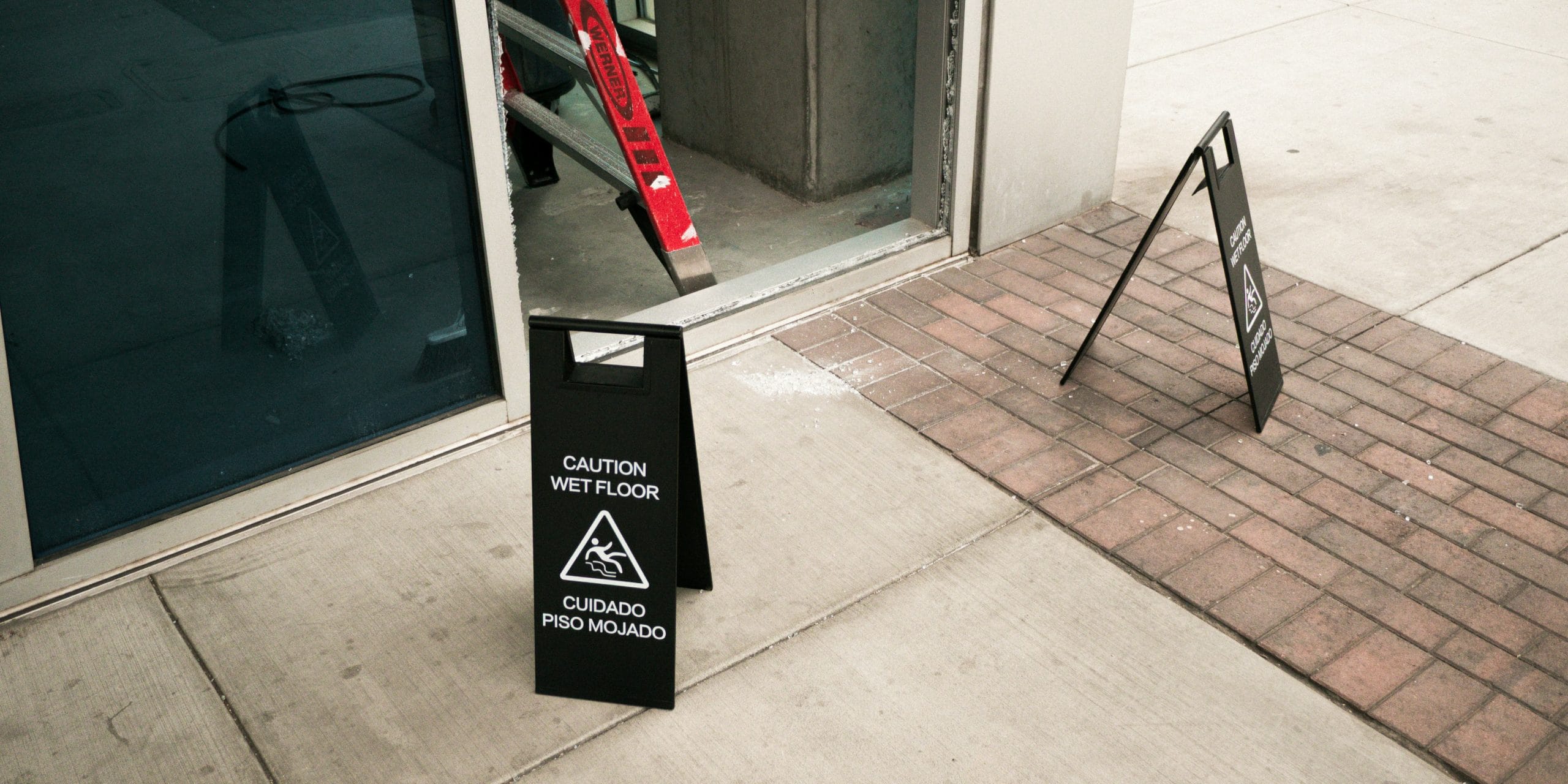
Wet or recently mopped floors without warning signs are among the most common hazards in commercial slip and fall claims. Poor lighting in stairwells, parking areas, and walkways also shows up often, since it hides hazards that would otherwise be avoidable. Broken or uneven steps, torn carpeting, cluttered walkways, and icy or unsalted entryways round out the most frequently cited conditions.
When Property Owners Are Not Liable
Property owners are generally not liable when the hazard was open and obvious, when the owner had no actual or constructive notice, or when the owner took reasonable steps to address the hazard within a reasonable timeframe. A wet floor with a clearly visible warning sign, for example, often shifts more responsibility onto the visitor to exercise caution.
Owners are also typically not liable for hazards they neither created nor had a reasonable opportunity to discover, such as a spill that occurred moments before the fall.
How Comparative and Contributory Negligence Affect a Claim
Even in a strong claim, an injured person’s own actions can reduce or eliminate the compensation available. If someone was distracted, ignored a posted warning, or was somewhere they shouldn’t have been, a portion of the fault may be assigned to them.
What Evidence Strengthens a Slip and Fall Case
Photos of the hazard taken as soon as possible, incident reports filed with the property, witness contact information, and medical records documenting the injury all strengthen a claim. Surveillance footage, where available, is often the single most persuasive piece of evidence, since it can directly show how long a hazard existed before the fall.
Waiting too long to document the scene or seek medical attention can weaken an otherwise strong case, since gaps in the record make it easier to dispute causation or timeline.
How Insurance Factors Into a Slip and Fall Claim
Most slip and fall claims against a business or property owner are handled through that property’s general liability insurance rather than paid directly out of pocket. Insurance adjusters typically investigate notice and reasonable care in much the same way a court eventually would, which is why early documentation matters even before a lawsuit is filed.
Steps to Take Immediately After a Slip and Fall Injury
Seek medical attention first, even if the injury seems minor, since some injuries don’t show symptoms right away, and a medical record close to the incident date supports the claim later. Report the fall to the property owner or manager and ask for a written incident report.
Photograph the hazard, the surrounding area, and any visible injuries before conditions change. Get contact information from any witnesses, and consider consulting a licensed attorney before speaking with an insurance adjuster about a settlement.
Comparative Negligence Rules by Standard Type
| Standard | How Fault-Sharing Works | Effect on Compensation |
|---|---|---|
| Pure comparative negligence | Fault is divided by percentage between both parties | Compensation reduced by the injured person’s percentage of fault, even if that percentage is high |
| Modified comparative negligence | Fault is divided by percentage, with a cutoff threshold | Compensation barred entirely if the injured person’s fault meets or exceeds the state’s threshold |
| Contributory negligence | Any fault by the injured person can bar recovery | Compensation may be denied entirely if the injured person is found even minimally at fault |
The Bottom Line
Every case turns on its specific facts and the law of the specific state where the injury occurred.
Injured on Someone Else’s Property? Hold Negligent Owners Accountable.
A serious slip and fall accident can disrupt your life in an instant, leaving you with severe injuries, growing medical bills, and missed time at work. Under Texas premises liability law, property owners have a strict legal duty to maintain safe premises. When they fail to fix hidden hazards, they must be held responsible for the harm they cause.
The Law Office of Ignacio G. Martinez steps in immediately to subpoena crucial surveillance footage, challenge attempts to blame you for the fall, and demand the full civil compensation you deserve.
- Rapid Evidence Decay: Property owners frequently clean up hazards, repair defects, or overwrite security camera footage days after an incident.
- 100% Free Consultation: Discuss your injury with an experienced Brownsville slip and fall advocate at absolutely no cost or financial obligation to you.
Frequently Asked Questions
What do you need to prove for a slip and fall claim?
How long do you have to file a slip and fall lawsuit?
Every state sets its own statute of limitations for personal injury claims, and slip and fall cases are no exception. [STAT NEEDED: sourced statute-of-limitations ranges by state, since these vary and change over time.] Missing the filing deadline generally bars the claim entirely, regardless of how strong the underlying case is. Anyone considering a claim should confirm the specific deadline for their state as early as possible rather than assuming a general timeframe applies.
Can you sue if you slip on ice outside a business?
In many cases, yes, if the business had a reasonable opportunity to address the ice and failed to do so, for example, by not salting or clearing a walkway within a reasonable time after a storm. Some states apply specific rules to snow and ice removal timelines that differ from general premises liability standards. Weather conditions and how quickly a hazard formed relative to when it was addressed both matter to the analysis. Because snow and ice liability rules vary significantly by state and even by municipality, this is a category where confirming local law matters more than usual.
What is comparative negligence in a slip and fall case?
Comparative negligence is the legal framework many states use to divide fault between the injured person and the property owner when both contributed to the incident. Depending on the state, an injured person’s compensation may be reduced by their percentage of fault, or barred entirely if their fault crosses a certain threshold. This means two nearly identical falls can have very different outcomes depending on which state’s negligence standard applies. The comparison table above outlines the three common approaches at a high level.
Does insurance cover slip and fall injuries?
Most businesses and many property owners carry general liability insurance that’s designed to cover exactly this type of claim. Homeowners’ policies often include similar liability coverage for injuries that occur on residential property. Coverage details, limits, and exclusions vary significantly by policy, so the specific insurance situation matters as much as the underlying liability question. An injured person typically doesn’t need to know the details of the owner’s policy to file a claim, since that’s part of what gets sorted out during the claims process.
What if I was partly at fault for my fall?
Do I need a lawyer for a slip and fall case?
It depends on the severity of the injury and how straightforward liability is, but many people benefit from at least a consultation before dealing with an insurance adjuster directly. Insurers often investigate claims with their own interests in mind, and early statements can affect the outcome of a case. An attorney can help evaluate the strength of the notice and negligence elements, which are often the hardest parts of a claim to prove without legal experience. Many personal injury attorneys offer free initial consultations, which makes it low-risk to at least get an assessment.
What kind of compensation can a slip and fall victim receive?
Compensation in a successful slip and fall claim can include medical expenses, lost wages, and pain and suffering, among other damages, depending on the state and the specifics of the case. The exact damages available and how they’re calculated vary by jurisdiction and by the facts of the case. Anyone evaluating a potential claim should get a specific assessment rather than relying on general expectations about what a case might be worth.
See also: Common Injuries From Slip and Fall Accidents, Top Causes of Slip and Fall Accidents in Brownsville
About the Author
Ignacio G. Martinez is a dedicated personal injury and accident advocate based in Brownsville, Texas. Serving injured victims and families across Cameron County and the broader Rio Grande Valley, his practice focuses on securing comprehensive civil compensation from all liable parties following serious motor vehicle accidents and slip and fall incidents. He is a member in good standing of the State Bar of Texas, the Texas Trial Lawyers Association, and the Cameron County Bar Association.